
Metamodern Philosophy
A playful rereading of nihilism through metamodern philosophy.

By
Thiago Patriota
- Published
- July 11, 2023
- Reading
- 4 min read
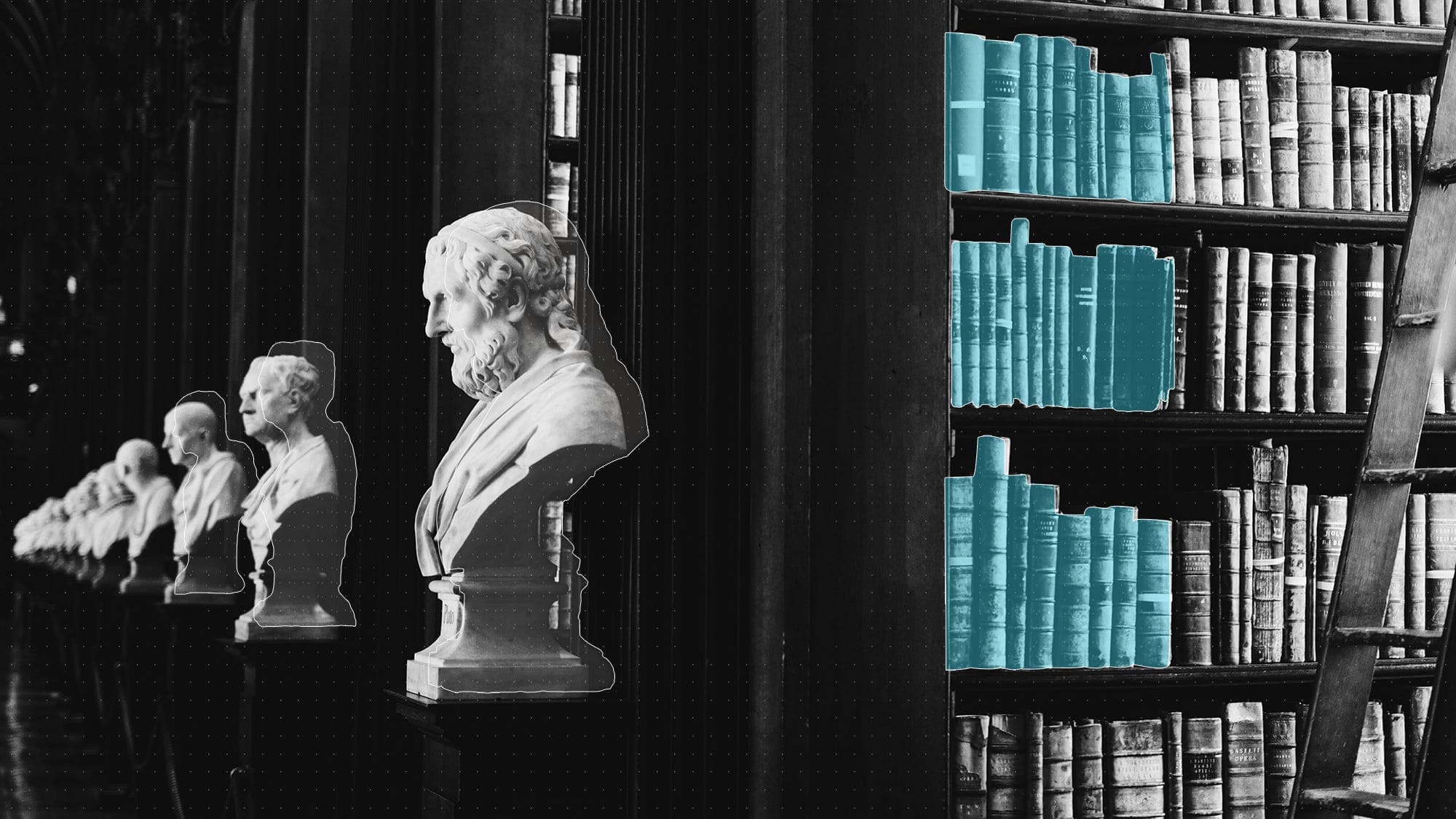
If the philosopher is truly the friend of wisdom and not necessarily the wise one, what would his position be in the liquid and metamodern era we live in today?
A weighted arm lift aims to damage muscle fibers so they regenerate with more muscle mass, strength and health. So it is with the exercise of philosophy, whose aim is to develop the reach of our critical reasoning through questioning in a way that expands the flexibility of our reason and understanding of things. Like the bruising of muscle, the exercise of philosophy also involves a certain kind of pain that differs from physical pain, because evolving our knowledge about what surrounds us ultimately distances us from many things that sometimes turn out to demonstrate a superficiality visible only to the philosopher's eyes, which in consequence ends up generating an abstract pain more similar to that of solitude.
But just as the athlete with a fit physique is able to persevere in a competition through training and discipline, the philosopher is also able to stand out in different areas of life, but it is precisely this that requires discernment and compassion from those who consider themselves thinkers, because with up-to-date training, the philosopher equips himself with knowledge that can be used to his advantage but first, fundamentally understands that a weapon, or a muscle, should never be used with the intention of attacking, but rather of defending and protecting.
New Times
For in a liquid modernity where quantity is valued above quality, not only consumer goods but also human relationships become obsolete quickly and as a consequence, the ability to delve into the power of collaboration and human companionship is lost because it is difficult to trust in people's moral constancy. Thus distancing human souls that, representing entire universes with their particularities, are capable of creating new worlds through collaboration.
The consequence of such an individualistic, cold and superficial context is an unsustainable inversion of moral values, principles and virtues that have always been essential for the progression of human evolution, then the metamodern philosopher, like an athlete who diligently trains his moral discernment, places himself in a position of advantage that must be used with the main and noble objective of uniting what is separated.
This approach differs fundamentally from what postmodern philosophy represents, which like nihilism, used the pain arising from philosophical exercise to distance itself even further from other thinking souls aiming for a search for power and control to fill a lack of alien identification that ended up resulting in bitterness, sadness and many other negative feelings. Wouldn't Nietzsche be a perfect example of this? Who in his pursuit of truth ended up arguing for the death of God, criticizing religions, deconstructing moral values and pointing to individualism as the paradoxical solution to life in society?
Back to Childhood
So, if we must exercise thought so that we can equip ourselves with arguments capable of generating love and uniting what has been separated, let us imagine life as a deep box of lego toys, where infinite pieces of different colors and shapes can fit together compatibly, thus giving the possibility of building any dream that is first born in the perfect world of ideas that inhabits the dimension of our mind.
As in the head of a child who is still beginning the long journey of learning what the world has to offer, we must first separate everything that pertains to our senses (what is visible to the eyes, graspable to the hands, tasteable in the mouth…) and what according to Plato represents an abstract, untouchable and perfect reality, being this the world of ideas! This is the immutable and eternal world where is born and inhabits the singular human capacity to explore the extraordinary, for it will always be precisely that which is extraordinary, capable of igniting a flame in hearts that do not beat as before.
Just as the child, when opening the lego box, perceives that she can assemble the pieces in any way she imagines and create absolutely any toy, the philosopher navigates the world of ideas in the perfect process of marveling at every small detail of life, observing and admiring the way things work and questioning how it would be if perhaps they were different?
So, in the position of a child with a box containing infinite lego pieces before her, the metamodern philosopher embraces the world in a light and pure way by understanding that to be alive and have the capacity to think is simply the best gift she could receive and feeling grateful, it is precisely this gift that she will value and explore with the intention of not only finding different perspectives, but mainly finding new ways to unite these pieces that were created with the objective of functioning in the most perfect combination!
Conclusion
The metamodern philosopher will not separate from the other lego pieces because he understands that as David Hume taught in his "Hume's Law", one cannot deduce what ought to be from what is. In other words, a statement like "This is" differs from a more natural hypothesis like "This ought to be" by respecting the idea that the concept of truth will always be particular to each one and prevents the thinker from imposing his way of thinking to the same extent that he respects the subjectivity of others, since as Socrates taught in his philosophical maxim, we must always and at all costs assert that we know nothing, for denying this would be the same as asserting that we have already discovered all the pieces inside the infinite and fun lego box.
You may also like
All posts → № 01
№ 01From Abacus to Algorithm: The Dilemma of Artificial Superintelligence
 № 02
№ 02Sentient Manifesto
 № 03
№ 03