
without art, one dies of reality.
— Friedrich Nietzsche
Loading...
#001
Osmarinocósmica
2026 — 3508 × 4961 / 300dpi
Osmarinocósmica © 2026 by Thiago Patriota da Silva is licensed under Creative Commons Attribution-NonCommercial-NoDerivatives 4.0 International


Hybrid Creation Certificate
Made with American artificiality and Brazilian Super Intelligence
001
About the Work
Technical Sheet
Work: Osmarinocósmica, 2026
Category: Cosmographic Allegory in Digital Engraving / Poster-manifesto
Technical Characteristics:
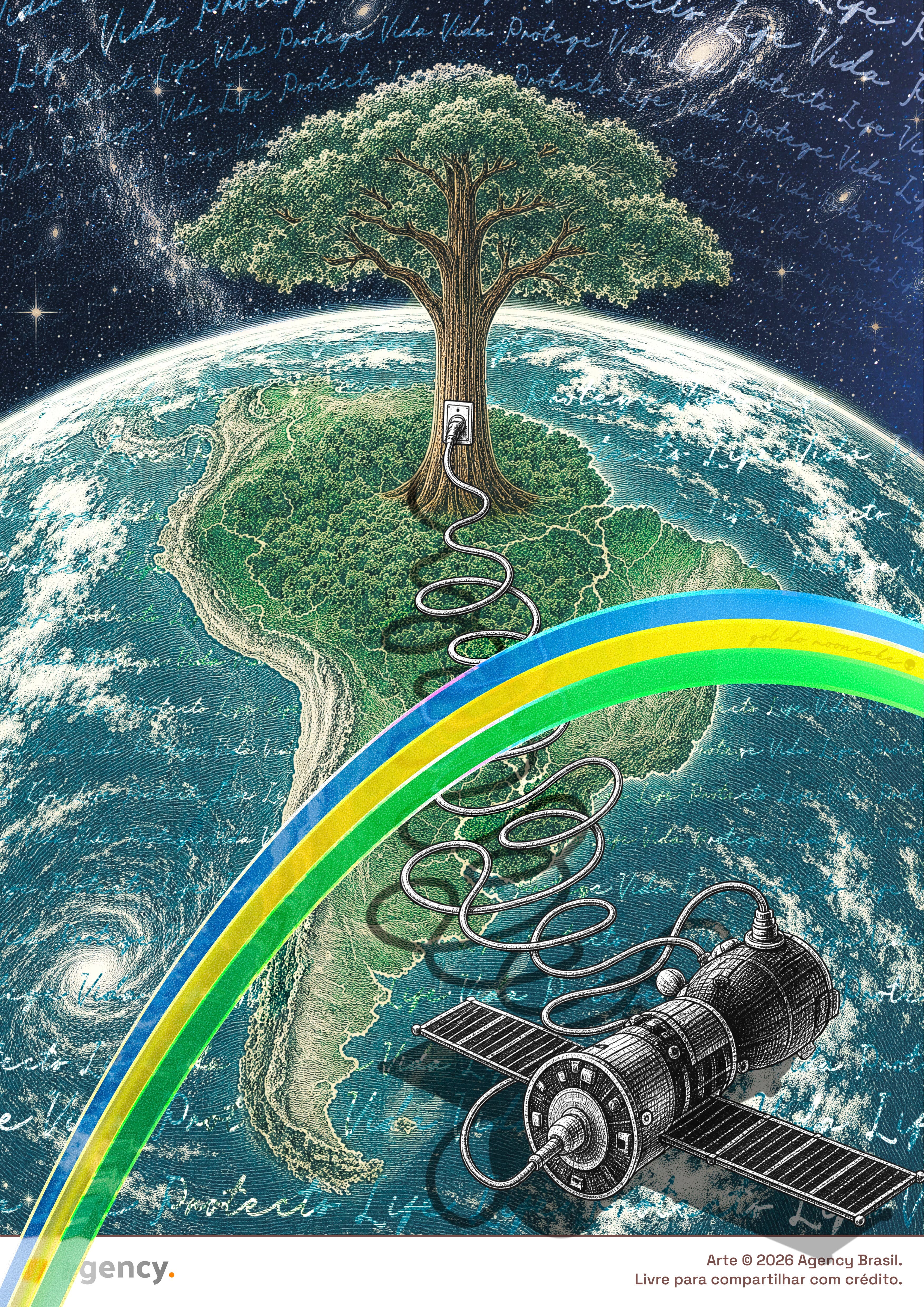
The poster inherits from the 19th-century cosmographic engraving (Flammarion) the gesture of looking at the world from outside and revealing the machine behind the sky. From surrealism (Magritte) comes the displacement of the banal object, with the shot embedded in the trunk. Brazilian ecological art (Frans Krajcberg) renders the Amazon as a political body, and contemporary pop maximalism supplies the neon rainbow in the colors of the flag. The result is an allegory where nature, cosmos, and technology are connected by the same thread.
Credits — Reference Images
Perhaps all the resources used in this work were stolen — arrest me if you can 😘

This art is courtesy of
newsletter.agencybrasil.com
The work Osmarinocósmica is a humble tribute to the most beautiful, fantastic, and inspiring woman of the Federative Republic of Brazil, also known as Maria Osmarina Marina da Silva Vaz de Lima. We have a pau-brasil tree of galactically monumental size rising from South America and representing about 38 years of public career with masterful loyalty to the environmental cause, which this brilliant woman always wore as a flag, the same way one would wear their own skin: with biological purpose. The homage, through the osmarinocósmico legacy of Osmarina Marina Silva, also aims to raise awareness about the productive potential of women in modern society, which still insists on propagating as cultural, economic, or aesthetic standards the archetypes of the heiress, the housewife, the influencer, and ultimately the Kardashian, when in reality, many brilliant women in human history have already been capable of transcending the limits of the status quo and social conventions to leave a truly heroic legacy for the scientific, political, and cultural progress of humanity, like Marina Osmarina Silva and like Ada Lovelace, who wrote one of the first computational algorithms, which eventually became the terminal I use to write this text.
After all, it is in The Republic, by Plato, one of the first texts to conceptualize democracy and political regimes in the West, that it is argued, over 2,400 years ago, that there is no function in the governance of the city that belongs to a woman as a woman, nor to a man as a man: natural talents are distributed between both sexes, and what separates them is merely biological, since one fertilizes and the other gestates. Pressed by his pupils, Socrates does not retreat: he argues that women should receive the same education as men and be able to hold the highest positions in Kallipolis, including those of guardians and rulers. If Plato's perfect city already envisioned women in command, it is at the very least curious that so many modern democracies, which claim to be heirs of the Greeks, still treat as an exception what the philosopher treated as a principle. Osmarinocósmicais born from this mismatch: it is the tree that grows from the soil of Brazil to the cosmos to remind us that feminine potential was never small — it was merely pruned. In other words: it doesn't matter whether a guard dog is male or female, both can tear you apart with their bite.
This work was inspired by and inherits the aesthetic of the Flammarion Engraving, an anonymous woodcut that appeared in 1888 in the popular science literature about atmosphere and climate L'atmosphère: météorologie populaire, written by Camille Flammarion. The engraving ended up helping spread a myth: that people in the Middle Ages believed in a flat Earth. Most medieval scholars knew it was spherical. Even so, the image survived because it speaks to something greater than astronomy: the human desire to cross the veil and see how the external and internal universe work. That is why it is embraced by science, esotericism, alchemy, counterculture, and even by my paintbrush, all at the same time.
The creative epiphany behind this work also carries transcendentally economic implications — because the year is 2026 and we still have many flat-earthers out there, don't we? Most of them even accept the notion that the Earth is indeed spherical but refuse to believe in the imminent phenomenon of global warming that threatens their ignorant lives while also increasingly threatening the bright future of new generations — who will also need oxygen and fertile soil to grow food (makes sense or not?).
There is a false notion that the most valuable commodities for nations are only the usual ones: fuel, rare earths, and critical minerals. They are still worth gold, but the new trend is dating naked the carbon market: an industry created to generate private and state fiduciary wealth from the effort to preserve the environment. The problem is that the complexity of this market still hinders its adoption, when it would suffice for industries and companies around the world, especially the big techs, to pay tributes for the carbon they emit into the environment, and for that value to remunerate the standing forests absorbing said carbon, so we would all be quintillionaires, especially in Brazil, where the Osmarinocósmica of the Amazon, as long as it stands, is worth more to humanity than all the oil the United States could extract by colonizing every nation on earth. I'm not saying anything that absurd, it's the simple idea (with American DNA) of selling the shovel to the gold miner and still charging rent for the hole (or air). The first person to talk about stockpiling wind was the genius and current president of the NDB (New Development Bank) of the BRICS. So there is nothing truly new under the sun, just visionaries being misunderstood as always. Haux Haux.

Agency Brasil — Issue #11
Read more about the carbon market in Issue #11 of Agency Brasil, published on April 6, 2023.
Read now →Loading...

#002
Preto & Branco Véio
2026 — 3508 × 4961 / 300dpi
Preto & Branco Véio © 2026 by Thiago Patriota da Silva is licensed under Creative Commons Attribution-NonCommercial-NoDerivatives 4.0 International

Hybrid Creation Certificate
Made with American artificiality and Brazilian Super Intelligence
002
About the Work
Technical Sheet
Work: Preto & Branco Véio, 2026
Category: Allegorical Portrait in Digital Engraving / Poster-effigy
Technical Characteristics:
The poster inherits from the intaglio engraving of banknotes and stamps the gesture of transforming a face into an official effigy. From Pop Art (Warhol) comes the portrait of the leader as icon, and from Tropicália the mixture of national symbols, popular faith, and mass culture as allegory of the country. Afro-Brazilian religious art (Rubem Valentim, Abdias Nascimento) provides the presence of the Preto Velho, with the rosary and the embracing hand, and contemporary surrealist pop provides the hyperrealism and irony of the accessories. The result is an allegorical portrait that unites the solemnity of the republican effigy with Afro-Brazilian memory and the ironic language of the internet.
Credits — Reference Images
- 01Abolition of Slavery — Victor Meirelles, 1888. Oil on canvas, 46 × 55 cm. Brasiliana Iconográfica Collection / Itaú Cultural. Public domain.
- 02200 Years of the Federal Senate — Agência Senado, 2018. Documentary photography. Flickr / Agência Senado. CC BY 2.0 License.
- 03Independence or Death — Pedro Américo, 1888. Oil on canvas, 415 × 760 cm. Museu Paulista da USP, São Paulo. Public domain.
This art is courtesy of
newsletter.agencybrasil.com
The work Preto & Branco Véio also emerged as a response to the presidential debate on October 18, 2026 on Band TV. Focusing on the comments made about prisoners' right to vote, I decided to bring the topic into discussion in a way that reclaimed Black Brazilian culture, given that the Black population is the majority in the country's prisons, a fact with social implications that transcend the racial question. Flávio Bolsonaro spoke about prisoners as if they were not human beings worthy of exercising the constitutional act of democratic voting, or as if here in Brazil we had the same prison system as the United States of America, where prisoners are part of a financial pyramid disguised as an industry that profits heavily from the containment of human lives without necessarily caring about the social reintegration of the convicted. For far-right conservatives, the poor, minorities, and non-Caucasian races tend to fit the same profile — the criminals, so this work aims to make a racial-religious-cultural intervention by placing the arm of a "preto véio" (old Black man) resting on President Lula's chest while showing protection and prayer. The pemba chalk enters as an accessory not only to make our president more fantastically beautiful but also to bring the material of chalk and the power of education into the equation, reminding everyone that Luiz Inácio Lula da Silva is, above all, a great global professor of politics for many aspirants around the world. Another purpose of the pemba chalk was to reinforce the symbolism of Umbanda and Candomblé, Brazilian religions that in the 2022 Census totaled about 1.8 million people, equivalent to 1% of the population aged 10 or older. (Whoever reads this first gets ahead.)
Lastly, in the upper part and background of the composition, we have 3 historical moments of the formation of our homeland, none of them is my birth on February 9, 1996, but they represent three canonical turning points that need no description. Hehe. XOXO Princess Isabel.
About the Author
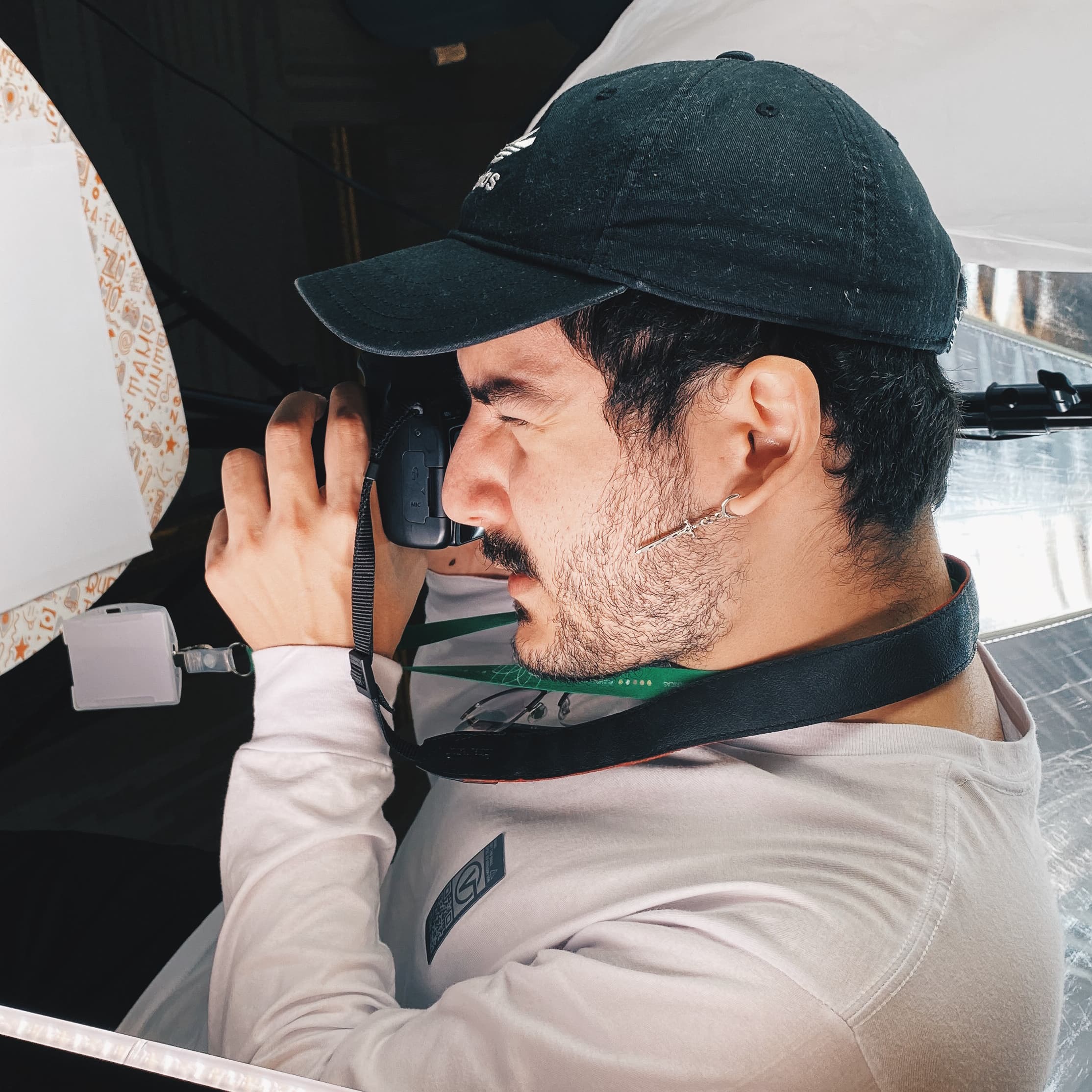
Thiago Patriota
Founder of Sentient and Doctor of Philosophy (Self-granted title)
Creative Director, brand strategist, photographer, and educator with over a decade of experience building brands from concept to market in the United States, Latin America, and Brazil. Specialized in branding, UX/UI design, product design, growth marketing, and pitch development for startups and established companies. Proven track record in the cannabis, tech, tourism, and creative industries. University professor with a pedagogical focus on critical thinking, strategic design, and preparing professionals for an AI-native economy.
Licensed rubber tapper in the forest and Shaman Ausûb in the village.